时间:2026-07-08来源:网络作者:adminf


Premium Recommendation — Chenghua Period Ming Dynasty Blue and White Palace Bowl with Kui Dragon Motifs
*本次藏品:明成化青花夔龙宫碗*
典藏尺寸:口径:16cm 底口径:6.5cm 高:9cm
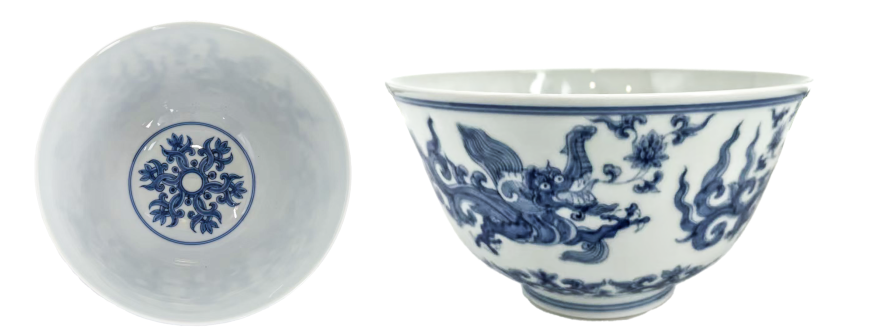
明代官窑器型有着严苛的等级划分,宫碗专为皇室内廷使用,从弧度、壁厚、收足、口沿都有统一御窑规范。这件夔龙宫碗整体为经典敞口撇沿,碗壁自口沿向下缓缓收束,腹部圆润饱满,圈足低矮规整,是成化朝最流行的 “宫碗” 制式。这件明成化青花夔龙宫碗,集标准宫碗制式、平等青淡雅发色、祥瑞夔龙纹饰与标准官窑款识于一体,是见证成化官窑审美、工艺、礼制的完整标本,藏着大明王朝中期独有的温润雅致,亦是古瓷收藏界趋之若鹜的顶级珍品。
“宫碗” 之名,自明代成化始定,专为宫廷御膳、陈设烧制,是明代官窑最具代表性的经典器型,有严格统一的形制规范,绝非民间日用粗碗可比。这件夔龙宫碗尺寸规整,口径 16cm,底径 6.5cm,通高 9cm,完美贴合成化官窑宫碗标准比例,一眼便能窥见皇家制器的极致法度。
整体器型为经典撇口敞沿,口沿向外微微舒展,线条圆润柔和,无生硬棱角;自口沿向下缓缓收束,弧壁饱满流畅,腹部丰盈却不显笨重,碗底向内收敛,搭配小巧精致的浅圈足,整体重心稳而轻盈。捧于手中,便能直观感受到成化独有的薄胎厚釉工艺:胎土选用景德镇顶级 “高岭土 + 瓷石” 二元配方,淘洗、陈腐、揉泥工序繁复至极,胎壁厚薄均匀,上手轻若无物,敲击之声清脆温润,无闷浊粗重之感。
碗内外通体施一层肥厚温润的白釉,釉面泛淡淡的青白色,业内俗称 “卵白釉”,釉水匀净饱满,光泽柔和内敛,没有刺眼的玻璃光,手抚之上顺滑如羊脂玉,这是成化官窑独有的配釉工艺,后世仿品很难复刻这般温润的釉面质感。将青花纹饰衬得清雅柔和。口沿内外各绘一圈细青花双圈线,底部近足处同样环绕缠枝花卉边线,分层规整,线条粗细均匀,彰显御窑画师下笔的极致控制力。
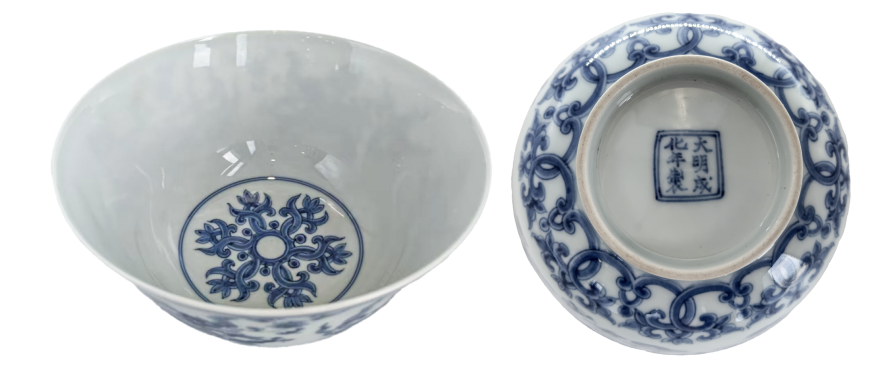
碗内壁留白柔和,淡青釉面澄澈通透,碗心正中绘制八瓣宝相团花,以双圈青花栏界定画面。八朵缠枝花卉向中心环绕舒展,卷草枝蔓婉转交错,圆点宝珠点缀其间,线条婉转灵动,对称工整却毫无呆板之气。内壁隐现淡墨式浅淡云纹暗刻,若隐若现,光线转动时方能窥见细腻肌理,内外纹饰一繁一简,虚实相生,尽显成化官窑藏于细节的巧思。整器线条柔和无尖锐棱角,摒弃永宣青花雄浑厚重的硬朗感,转向含蓄温婉的圆润线条,完美契合成化皇帝朱见深偏爱的柔和雅致审美。
Official Ming porcelain vessels were subject to strict hierarchical classification. Palace bowls were exclusively produced for the imperial inner court, with uniform imperial kiln standards governing every detail from curvature and wall thickness to foot tapering and rim design. This Chenghua blue-and-white Kui Dragon Palace Bowl embodies the canonical palace bowl form, the soft, muted hue of equal blue cobalt pigment, auspicious Kui Dragon motifs, and authentic imperial kiln reign marks. A complete specimen that bears witness to the aesthetics, craftsmanship and ritual systems of Chenghua imperial porcelain, it encapsulates the unique gentle elegance of the mid-Ming Dynasty, ranking among the most coveted top-tier treasures for antique porcelain collectors.
The term "Palace Bowl" originated in the Chenghua reign of the Ming Dynasty. These bowls were custom-fired for imperial dining and display, standing as the most iconic classic vessel shape of Ming official porcelain. They adhered to rigid, unified shape regulations, setting them worlds apart from crude civilian daily-use bowls. This Kui Dragon Palace Bowl boasts perfectly standard dimensions: a mouth diameter of 16 cm, base diameter of 6.5 cm, and total height of 9 cm, matching the canonical proportional standards for Chenghua imperial palace bowls, instantly revealing the uncompromising precision of imperial craftsmanship.
It features a classic flared open rim that gently flares outward with soft, rounded lines free of harsh edges. The wall tapers smoothly downward from the rim, with full, fluid curved sides. Its plump belly never appears bulky, tapering gently toward the base paired with a delicate, low shallow foot, granting the vessel a stable yet lightweight center of gravity. Held in the hand, one can directly experience the signature thin-body thick-glaze technique unique to Chenghua porcelain. The body clay adopts Jingdezhen’s premium dual-ingredient formula of kaolin clay and porcelain stone, subjected to extremely elaborate processes of washing, aging and kneading. The even wall thickness lends an almost weightless feel, and when tapped, it emits a clear, mellow tone rather than dull, heavy thud.
The interior and exterior of the bowl are fully coated in a thick, lustrous white glaze bearing a faint pale cyan tint, known within the trade as "egg-white glaze". The glaze layer is even and full, with a soft, restrained luster lacking harsh glassy glare, feeling as smooth as mutton fat jade to the touch. This exclusive glaze formulation of Chenghua imperial kilns has proven nearly impossible to replicate in later imitations, setting off the blue-and-white painted motifs with delicate, understated grace. Thin double blue-and-white border lines trace both the inner and outer rims, while a scrolling floral band encircles the vessel near the foot. Each layered design follows strict proportions, with uniform line thickness that testifies to the masterful brush control of imperial kiln painters.
The bowl’s interior features soft blank space beneath its translucent pale cyan glaze. At the very center of the bowl’s floor lies an eight-petaled treasure flower medallion framed by a double blue-and-white circular border. Eight scrolling floral sprigs unfurl outward in symmetrical formation, interwoven with winding scroll grass vines dotted with tiny bead ornaments. The fluid, lively lines achieve perfect symmetry without appearing rigid. Faint, subtle engraved cloud patterns lie hidden beneath the interior glaze, only their delicate texture visible as light shifts across the surface. The contrast between elaborate exterior decoration and restrained interior ornament creates a harmonious interplay of solid and void, showcasing the meticulous ingenuity woven into every detail of Chenghua imperial porcelain. Rejecting the bold, rugged angularity of Yongxuan blue-and-white wares, the vessel’s uniformly soft lines embody the understated, gentle elegance favored by Emperor Zhu Jianshen of the Chenghua reign.
*本次藏品:明成化青花夔龙宫碗*
典藏尺寸:口径:16cm 底口径:6.5cm 高:9cm
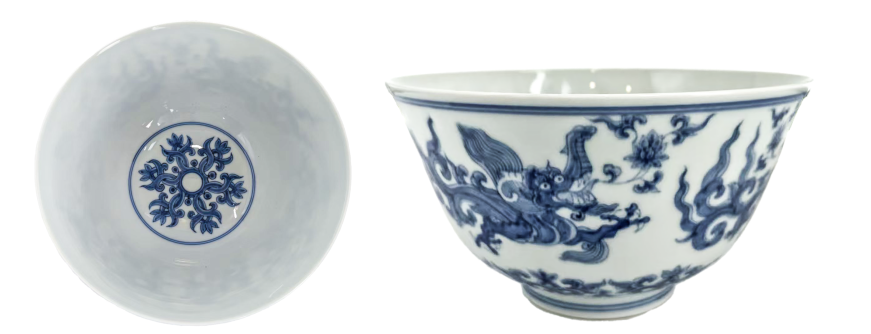
碗外壁主纹饰为双夔龙穿缠枝莲纹,是成化官窑标志性的经典题材,区别于永宣朝威严霸气的五爪行龙,成化夔龙被赋予了温顺灵动的全新气质。 何为夔龙?古籍载 “夔,一足神兽,音如雷,主祥瑞”,明代中期将夔龙简化为无角、卷身、长吻、双翼的神兽形象,弱化了龙的威严,增添柔美飘逸的气韵,契合成化朝内敛柔和的宫廷风气。碗身两条夔龙首尾呼应,穿梭于缠枝莲花之间,龙身线条以流畅的青花勾勒,分层渲染出深浅明暗,龙鳞、背鳍、翼纹一笔一画细致入微,双目圆睁灵动传神,卷尾随花卉藤蔓婉转舒展,全无凶猛凌厉之感,反倒如游云戏水,悠然自在。 缠枝莲纹穿插缠绕于夔龙身侧,莲花花瓣饱满舒展,枝蔓卷曲婉转,线条连绵不断,在传统文化中,莲花寓意清廉高洁,缠枝纹样象征生生不息、富贵绵长,夔龙则代表皇室祥瑞、皇权安泰,二者结合,是明代宫廷最受推崇的吉祥组合纹样。 青花用料采用成化官窑专属 “平等青”,又称 “陂塘青”,产自江西乐平。不同于永宣苏麻离青浓重深邃、自带铁锈斑的浓烈色调,平等青发色柔和淡雅,蓝中泛灰青,层次温润柔和,没有浓重的晕散,画师可精准分层填色,完美表现夔龙与花卉的细节层次。画面留白恰到好处,疏密平衡,不拥挤不空洞,充分体现成化绘画 “疏淡清雅” 的艺术特色,对比永宣青花满工繁密的构图,自成一派温柔简约的文人审美。
翻转观碗内壁,素白釉面洁净素雅,仅碗心圆形开光内绘制一组六出宝相团花,内外双青线圈定边界,构图对称圆满,是成化官窑经典内心装饰。 宝相花源自唐代佛教纹饰,融合莲花、牡丹、卷草纹样,是皇家专属吉祥纹样,象征圆满、清净、富贵。此碗心团花六组花叶对称环绕中心圆芯,卷瓣婉转交错,搭配细小圆点宝珠点缀,线条工整对称,一笔不苟,六瓣花叶均匀分布,暗含 “六时吉祥” 的佛教寓意。内壁大面积留白,仅以碗心一朵团花点睛,内外纹饰形成 “外繁内简” 的鲜明对比,层次丰富,设计巧思十足。 古人观瓷,先观外壁,再赏碗心,用餐时低头便能看见这朵圆满宝相花,时刻承载皇室对平安圆满的祈愿。内壁白釉匀净通透,微微泛青的底色衬得青花蓝纹愈发清雅,光线照射下釉面泛起温润柔光,细腻的釉面质感是民间窑口无法企及的御窑水准。
碗底圈足内,青花双方框内书写楷书 “大明成化年制” 六字款,是鉴定成化官窑的核心标准。 成化款识自成一派,字体为标准楷书,字体圆润无棱角,笔画粗细均匀,“大” 字尖头、“明” 字月部窄长、“成” 字斜勾柔和、“化” 字人撇舒展、“年” 字横画平稳、“製” 字衣部收束规整,六字排布疏密均衡,藏锋内敛,没有锋芒毕露的笔锋,是明代官窑款识里辨识度极高的 “成化款”。 书写所用青花料与器物纹饰用料同源,发色淡雅下沉,笔画深入釉下,无漂浮感,方框线条粗细均匀,四角转角圆润,绝非后世仿品生硬刻板的临摹字体。圈足修胎规整,足墙深浅适度,足底露胎处呈现细腻浅淡的米黄色胎质,俗称 “米糊底”,是成化官窑烧制过程中自然形成的胎土特征,胎土细腻无粗砂颗粒,御窑淘洗炼胎工艺一览无余。 在明清陶瓷收藏界流传 “明看成化,清看雍正”,成化官窑存世量稀少,带完整原款、纹饰完整无残缺的夔龙宫碗更是凤毛麟角,每一件成化标准款官窑器,都是陶瓷史断代、工艺研究的核心实物资料。
成化青花的独特气质,根源在于明宪宗朱见深的个人性格与时代背景。宪宗幼年历经皇位动荡,性格温和内敛,不喜永宣时期雄浑霸气的大器、浓烈奔放的青花,偏爱小巧、温润、素雅的瓷器,御窑完全贴合帝王审美,烧制出一批小巧精致、气韵柔和的宫廷用瓷。同时,成化朝御窑分工细化,制瓷、绘画、写款、施釉各有专职匠人,工艺达到空前精细化:胎土反复淘洗,釉料多重调配,画师分工绘制花鸟龙纹,写款匠人专职落款,每一道工序都有严格标准,这件宫碗从器型、纹饰、青料、款识、釉面全维度符合成化官窑御制标准,完整保留明代中期官窑的原始工艺特征。
历史研究价值:完整留存成化标准器型、夔龙纹样、平等青发色、标准六字款,是研究明代御窑制度、宫廷纹饰、陶瓷颜料、款识书法的一手实物,具备极高文博研究价值。
艺术审美价值:平衡淡雅的青花色调、疏密有致的构图、温润如玉的釉质,代表明代中期陶瓷绘画最高美学水准,区别于元、永宣、嘉靖青花,形成独一份的成化美学体系。
稀缺收藏价值:市场流通完整成化官窑器极少,同类夔龙纹宫碗多馆藏于故宫、台北故宫、各大海外博物馆,民间完整传世品稀缺,具备极强的保值、升值潜力,是高端古瓷收藏的核心品类。
文化传承价值:夔龙、宝相花、缠枝莲三重传统吉祥纹样融合,承载明代皇室祥瑞文化、佛教融合美学,是中华传统吉祥文化、宫廷礼制文化的实物载体。
The main decorative motif covering the bowl’s exterior wall is a pair of kui dragons winding through interlocking lotus sprigs, an iconic classic theme of Chenghua imperial kiln porcelain. Unlike the imposing, powerful five-clawed walking dragons of the Yongle and Xuande reigns, the kui dragons of the Chenghua era are endowed with a mild, lithe new temperament.
What exactly is a kui dragon? Ancient texts record: “The kui is a one-legged divine beast whose roar echoes thunder, an omen of auspicious fortune.” By the mid-Ming Dynasty, the kui dragon was stylized into a hornless mythical creature with a coiled body, elongated snout and pair of wings. Its fearsome draconic aura was softened, replaced by a graceful, flowing charm that matched the reserved, gentle courtly ethos of the Chenghua reign. Two kui dragons are painted across the bowl’s body, their heads and tails echoing one another as they weave through scrolling lotus blooms. Fluid cobalt blue outlines define their bodies, layered washes creating subtle shifts of light and shadow. Every scale, dorsal fin and wing vein is rendered with meticulous precision; their round, wide eyes radiate vivid liveliness, while curling tails unfurl alongside twisting floral vines. Stripped of all ferocity, the dragons glide as lightly as clouds drifting over rippling water, serene and unhurried.
Scrolling lotus vines twist and interlace beside the kui dragons, their lotus flowers full and open, stems winding in unbroken, continuous lines. In traditional Chinese culture, the lotus symbolizes integrity and purity, while scrolling patterns stand for endless vitality and lasting prosperity. The kui dragon, meanwhile, embodies imperial auspiciousness and stable reign. Their pairing forms the most revered auspicious decorative combination in Ming imperial courts.
This bowl is painted with Pingdeng Qing, the exclusive cobalt pigment of Chenghua imperial kilns, also known as Pitang Qing, mined in Leping, Jiangxi Province. Distinct from the deep, rich Su Ma Li Qing cobalt used in Yongle and Xuande wares — which bears prominent iron rust speckles — Pingdeng Qing yields soft, muted blue tinged with greyish cyan. Its gentle, layered tones show minimal ink bleeding, allowing painters to apply color in precise graded washes and fully capture fine details of the kui dragons and flowers. The painting masterfully balances blank space with ornamentation, neither overcrowded nor sparse, fully embodying the Chenghua artistic hallmark of “subtle, elegant restraint.” In stark contrast to the dense, fully covered compositions of Yongle and Xuande blue-and-white porcelain, it forges a unique gentle, minimalist literati aesthetic.
When flipped to view the interior, the plain pale white glaze is clean and understated. Only the circular medallion at the bowl’s center holds a six-petaled treasure flower rosette, framed by double concentric cobalt blue lines that demarcate the scene. The perfectly symmetrical, rounded composition ranks among the classic interior decorations of Chenghua imperial wares. Originating from Buddhist decorative patterns of the Tang Dynasty, the treasure flower blends lotus, peony and scroll grass motifs as an exclusive auspicious symbol for the imperial family, representing perfection, purity and wealth. The rosette at this bowl’s center features six groups of flower leaves symmetrically encircling a central core, interwoven with curved petals dotted by tiny bead ornaments. Every line is neatly balanced and painstakingly executed, with six evenly distributed floral segments that carry the Buddhist symbolic meaning of “auspiciousness at all six hours of the day.” The bowl’s interior relies largely on blank space, with the central rosette serving as a subtle focal point, creating a striking contrast of “elaborate exterior, restrained interior” that delivers layered depth and ingenious design.
Ancient connoisseurs of porcelain would first admire a vessel’s exterior, then turn to appreciate its central medallion. When dining, one would glance down to behold this perfect treasure flower, a constant visual reminder of the imperial household’s prayers for peace and wholeness. The even, translucent pale white glaze of the interior bears a faint cyan undertone that makes the cobalt blue patterns all the more refined. Warm, soft light shimmers across the glaze when illuminated, showcasing a delicate textural quality unattainable by civilian kilns, a hallmark standard of imperial ceramic craftsmanship.
Within the recessed foot ring on the bowl’s base, the six-character reign mark Da Ming Chenghua Nian Zhi (Made in the Chenghua Reign of the Great Ming) is handwritten in regular script inside a double cobalt blue square frame, the core benchmark for authenticating Chenghua imperial porcelain.
Chenghua reign marks form a style all their own, rendered in standard rounded regular script without sharp angular strokes and consistent line thickness. Distinct stylistic traits define each character: the top stroke of Da (Great) tapers to a point; the lunar component of Ming (Bright) is narrow and elongated; the diagonal hook of Cheng (Chenghua) soft and gentle; the left sweeping stroke of Hua (Transform) broad and unrestrained; the horizontal strokes of Nian (Year) steady and level; and the lower radical of Zhi (Made) neatly contained. The six characters are evenly spaced with restrained, hidden brushwork, lacking sharp, aggressive flourishes — rendering the “Chenghua mark” one of the most instantly recognizable reign scripts among Ming official porcelain.
The cobalt pigment used for the inscription matches that of the vessel’s decorative motifs, its soft hue sinking fully beneath the glaze rather than floating on the surface. The square frame’s lines maintain uniform thickness with smoothly rounded corners, utterly unlike the stiff, mechanical copies produced in later eras. The foot ring is precisely trimmed with moderately deep vertical walls, and the unglazed base reveals fine, pale beige clay known within the trade as “rice paste base” — a natural textural feature formed during firing unique to Chenghua imperial kilns. The clay body holds no coarse sand grains, vivid evidence of the rigorous washing and refining processes exclusive to imperial kilns.
A well-known maxim among Ming and Qing porcelain collectors states: “For Ming porcelain, seek Chenghua; for Qing porcelain, seek Yongzheng.” Surviving Chenghua imperial wares are extremely rare, and intact kui dragon palace bowls bearing complete original reign marks with undamaged ornamentation are rarer still, comparable to phoenix feathers and unicorn horns. Every fully standard marked Chenghua imperial vessel serves as vital first-hand physical evidence for dating ceramic periods and researching ancient craftsmanship.
Historical Research Value
Retaining the canonical Chenghua vessel form, authentic kui dragon motifs, characteristic Pingdeng Qing cobalt tone and standard six-character reign mark, this bowl stands as primary physical material for research into Ming imperial kiln administration, court decorative iconography, ceramic pigments and reign mark calligraphy, carrying immense cultural and museum research significance.
Artistic and Aesthetic Value
Its balanced, muted cobalt blue palette, well-proportioned alternating ornament and blank space, and jade-like soft glaze embody the pinnacle of mid-Ming ceramic painting aesthetics. Distinct from Yuan, Yongle-Xuande and Jiajing blue-and-white wares, it established an independent, cohesive Chenghua artistic system.
Rare Collectible Value
Fully intact Chenghua imperial porcelain rarely circulates on the market. Most comparable kui dragon palace bowls are preserved in the Palace Museum, the National Palace Museum in Taipei and major overseas museums. Complete surviving examples held in private collections are exceptionally scarce, boasting strong value retention and appreciation potential to rank among core top-tier antique porcelain collectibles.
Cultural Heritage Value
Merging three core traditional auspicious motifs — the kui dragon, treasure flower and scrolling lotus — the vessel encapsulates Ming imperial auspicious culture and fused Buddhist artistic aesthetics, serving as a tangible carrier of China’s age-old symbolic culture and imperial ritual systems.
*本次藏品:明成化青花夔龙宫碗*
典藏尺寸:口径:16cm 底口径:6.5cm 高:9cm
以上藏品相关信息请与四川极蕴拍卖有限公司联系,我们将为您提供一对一专业服务。
For more information about this collection, please contact Sichuan Jiyun Auction Co., Ltd. We will provide you with one-on-one professional service.
崔景哲 千手观音当传统工笔重彩与大乘慈悲信仰相融,当代工笔画家崔景哲笔下的千手观音,便跳出了民间造像程式化的桎梏,以细腻入微的...
黑釉四系壶 大明宣德款青花僧帽壶 崔景哲 千手观音 大明成化青花缠枝宝相花碗:淡雅青花里的成

Copyright © 2002-2018 中国母婴网 版权所有 备案号:
站点声明:本网内容为转载,为广告,相关素材由广告主提供,广告主对本广告内容的真实性负责。
本网发布目的在于传递更多信息,并不代表本网赞同其观点和对其真实性负责,转载内容仅供读者参考。
如有站点名称冲突,侵权等请联系我们删除,请您监督!